Development
Start with an issue labelled good first issue: these say what should change and where. Comment on the issue before working on it. Everyone taking part follows the Code of Conduct.
Toolchain
Section titled “Toolchain”| Work on | Needs |
|---|---|
| userspace collector and CLI | Rust (stable), just |
| formatting | Rust nightly (rustfmt.toml uses unstable options) |
| eBPF programs | Rust nightly with rust-src, bpf-linker built against a matching LLVM |
| running the collector | Linux with cgroup v2 and BTF, root |
| harness and notebooks | Python 3.12+, uv |
| this site | Node.js 22.22 or later |
git clone git@github.com:<your-account>/croft.gitcd croftgit config core.hooksPath .githooksRepository layout
Section titled “Repository layout”croft/├── collector/ Rust workspace│ ├── collector/ userspace: CLI, polling, dataset writer│ │ ├── frameworks.json framework catalog, built in and replaceable│ │ └── src/│ │ ├── command/ one file per croft subcommand│ │ ├── sensing/ eBPF loading, maps, syscall names and rates│ │ ├── inspect/ /proc and cgroup readers, workload and framework│ │ ├── pipeline/ poll reporter, dataset rows, segments, /metrics│ │ ├── decision/ replicas a workload needs│ │ └── runtime/ logging, signals, terminal, HTTP│ ├── collector-ebpf/ eBPF programs (nightly Rust, bpf-linker)│ └── collector-common/ types shared by both sides├── deploy/ Docker, Kubernetes and systemd deployment├── labs/│ ├── k3s-cluster/ Ansible for the lab cluster│ └── research/experiment/ experiment harness (uv)├── website/ this site└── justfile task recipesHow a row is produced
Section titled “How a row is produced”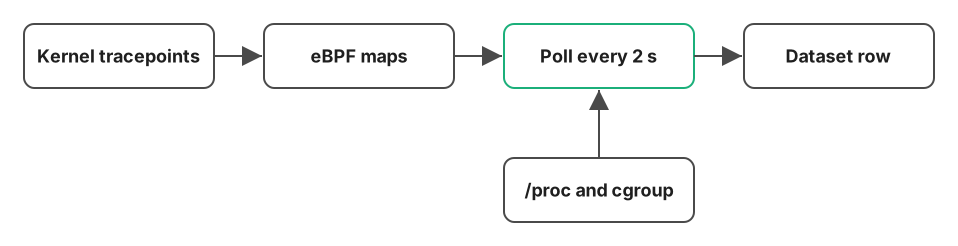
| Step | What happens |
|---|---|
| Kernel tracepoints | sys_enter counts calls per process and syscall in SYSCALL_BY_TYPE; GPU tracepoints fill GPU_FDS and GPU_ACTIVITY with GPU device fds and the ioctls sent through them; sched tracepoints add run queue wait per process |
| Poll every 2 s | userspace reads the maps and turns the counts into per-second rates |
/proc and cgroup |
/proc adds identity, framework, CPU, memory, I/O and network per process; cgroup v2 adds CPU, throttling, memory and PSI per container |
| Dataset row | one JSON line per process in /var/lib/croft/croft-dataset.jsonl, rotated hourly into zstd segments beside it |
Data sources lists every tracepoint and file the collector reads.
just test # unit testsjust lint # rustfmt --check (nightly) and clippy with warnings as errorsBoth build the eBPF program first. Without bpf-linker, skip it; the unit tests and clippy cover the userspace code and need no root, kernel or cluster:
cd collectorAYA_BUILD_SKIP=1 cargo test -p collectorAYA_BUILD_SKIP=1 cargo clippy -p collector --all-targets -- -D warningscargo +nightly fmt --all -- --checkWith AYA_BUILD_SKIP=1 the binary embeds an empty eBPF object: it builds, but croft run cannot load its programs. Changes to the eBPF programs or to how rows are written also need a run on a real host, checked with croft top and croft stats.
Code style
Section titled “Code style”- The smallest code that solves the problem; delete before adding; clear names over comments.
- One module per responsibility; no stage depends on one to its right.
- One source of truth per piece of knowledge; lists that grow go in a JSON file, not in code.
- Comments are rare and one line. Every
unsafeblock has a// SAFETY:comment. Nounwrap()orexpect()in the event path. - Files stay under 500 lines.
Commits
Section titled “Commits”The commit-msg hook checks the first line against Conventional Commits: type(scope): description, lowercase, at most 72 characters, no trailing period. Scopes: collector, labs, apps, research, website; omit for repository-wide changes.
The pre-commit hook runs rustfmt, clippy and the tests when a staged change touches collector/.
| Workflow | Does |
|---|---|
| Dependabot | weekly updates for Cargo, GitHub Actions, npm (website/), uv (labs/research/experiment) and Docker; minor and patch bumps come as one pull request per ecosystem, aya as its own |
pr-title |
checks the pull request title against the commit rule above, since a squash merge turns it into the commit on main |
links |
checks the Markdown links on pull requests that touch Markdown, and weekly; a broken link there opens a [DOCS] broken links issue |
release |
Release Please, below |
Releases
Section titled “Releases”Release Please reads the Conventional Commits on main and keeps a release pull request open: feat raises the minor version, fix the patch, while the version is below 1.0. The pull request updates CHANGELOG.md, the workspace version in collector/Cargo.toml, Cargo.lock and the chart version in deploy/helm/croft/Chart.yaml.
Merging it tags vX.Y.Z, publishes a GitHub release, pushes the image ghcr.io/danielcristho/croft:X.Y.Z and the chart oci://ghcr.io/danielcristho/charts/croft at X.Y.Z. The chart in the repository keeps appVersion: main; the release sets it to X.Y.Z when it packages the chart.
The current version lives in .release-please-manifest.json. To release a chosen version, such as 1.0.0, set "release-as": "1.0.0" in release-please-config.json before merging, and remove it afterwards.
This site
Section titled “This site”cd websitenpm installnpm run dev # http://localhost:4321/npm run build # static site in website/distPages are Markdown in website/src/content/docs/; the sidebar follows the folders.